About
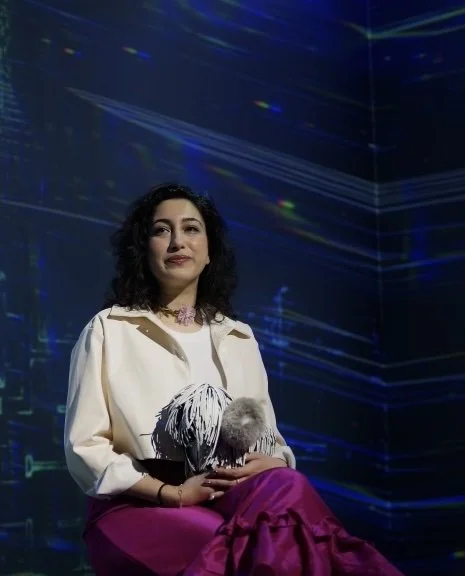
Elyana Shams is an Iranian multimedia and interdisciplinary artist based in Tehran, whose practice explores how memory, identity, and belonging shape our understanding of ourselves and the worlds we inhabit. Working across installation, moving image, spatial narrative, and emerging technologies, she creates works that examine how/what we remember, what we inherit, and how/what we choose to carry forward.
Her inquiry is rooted in a decade of practice as a landscape architect — a background that taught her to read environments as carriers of memory and to treat space itself as a narrative form. Her award-winning thesis, Yes, and... The Improvising Landscape of the Displaced, examined how people create belonging in environments never designed for them, drawing from the mechanics of jazz improvisation to explore adaptation and collective meaning-making. That spatial, community-rooted thinking remains central to her artistic practice today.
Born in Tehran and raised between cultures, Elyana spent nearly two decades abroad before returning to Iran in 2025. That experience of navigating multiple languages, places, and ways of seeing is the core of her explorations today. Alongside her personal projects, which continue to study the relationship between individual, collective, and cultural memory, and the role erasure plays in shaping all three, she has been leading an ongoing participatory project, بقا (survival), which uses literature, dialogue, and creative exercises to build a living archive of a particular time, place, and emotional landscape of current history in Iran as it unravels.
Her work has been exhibited internationally, including at the National Liberty Museum in Philadelphia (Cheshmee), Artechouse in New York (Invisible), CultureHub in New York (Revert), and manifest:io in Berlin (.... ..), across more than forty exhibitions in Iran, Europe, and the United States. In 2019 she presented her first solo exhibition, Do You See What I See?, at Ace Gallery in Tehran.
At the center of her practice is a belief that art creates spaces for recognition — moments where the personal becomes part of something larger than itself.